Showing posts with label GM advice. Show all posts

Tuesday, October 31, 2023

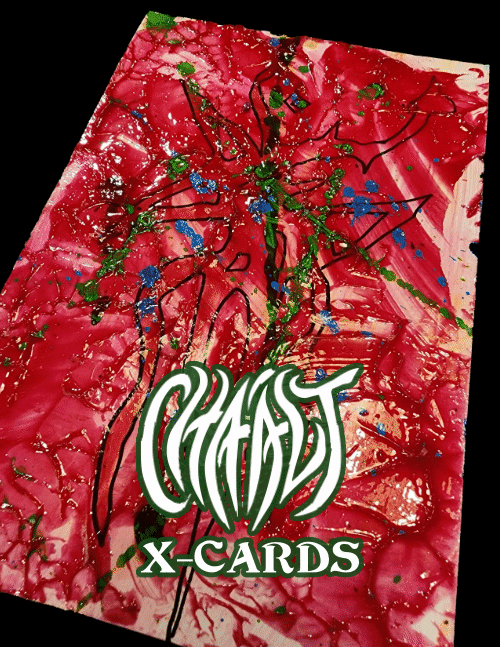
Cha'alt X-Cards


Cha'alt X-Cards have arrived!!!

The idea happened, we playtested it, and now it's a thing on DriveThru (for FREE)...

Here's the PDF on DriveThruRPG.

As a friend on Facebook said, instead of "No spiders," it's more like "More sleaze, please!"

Imagine empowering players to make the game more awesome just by holding up a card - without disempowering the Game Master.  

This is a way of creating Cha'altian sessions that could all too easily revert back to vanilla D&D.  I know... I created Cha'alt and even my imagination sometimes falls back into the comfortable rut of standard fantasy tropes.

And remember, you don't have to use Cha'alt itself to benefit from those Cha'altian vibes.  Use Cha'alt X-Cards with Lamentations of the Flame Princess, Dungeon Crawl Classics, Neon Lords of the Toxic Wasteland, or any game that values eldritch, gonzo, science-fantasy, post-apocalypse, humor, sleaze, pop-culture, and grindhouse exploitation!

In my estimation, this is even bigger than forever improving D&D combat with Crimson Escalation... this is a concept that takes the hobby of roleplaying games in exciting and new directions.  

Fiction first... for real!

It's a free PDF, so I hope you give it a try.  I'm currently busy custom-making Cha'alt X-Cards for friends, fans, and supporters of my work.

Enjoy,

VS

p.s. Cha'alt hardcovers are here.  Details and weekend badges for VENGER CON III: Revenge of the OSR are here.  And if you want a tentacle-made set of Cha'alt X-Cards by yours truly, paper is $15 and wood is $20 + $5 for shipping for one or multiple sets:  Venger.Satanis@yahoo.com


Thursday, May 25, 2017

The Sound They Make


I frequently go back to the OSR well of wisdom that is Grognardia.  Sure, there are posts about stuff that means nothing to me and a few posts where I very much disagree with +James Maliszewski (to be expected as individuals and individualists vary), but more often than not I'm rewarded with a look back at vintage OSR.

In this blog post, I wanted to highlight a Grognardia blog post from October 30th, 2012 that I just discovered.  About halfway down, James describes an account from someone who attended Games Fair '83...

It's also reported that Gygax "horrified a few of the purists with one remark," namely that "a good referee only rolls the dice for the sound they make. He just decides what happens!" While that comment might have been surprising in 1983, it's pretty well known nowadays that Gary had a lot more of the "storytelling" style as a referee than many old schoolers would themselves countenance in their own games.

If you'll remember my fairly recent post about rule zero, Gygax's statement is about as zero-ish as it gets.  His advice does not hail from the halls of traditional play-styles nor story-gaming, in my view.  It is old school itself - that indefinable quality of roleplaying that's as primordial as it is inspirational, where the game runs on pure imagination and flows of its own accord, influenced by the player-characters and directed by the Game Master.

Dice are awesome and they have many uses - no one is disputing that.  However, it is the GM who ultimately makes the call, navigating the current, and slyly exercising his will.  As with dice rolled, players should have their input, too - just not at the expense of the singular presence in charge of the game.

While many still disagree, I believe the evidence suggests what master Game Masters have known all along - trust your instincts; don't be badgered into making an "authorized" ruling.  You are the rule of law!  To put it another way, use the force...

After all, 40 years ago today the original Star Wars debuted in theaters across the country.  Happy Birthday Episode IV: A New Hope, and many happy returns!

VS

p.s.  I ran a quick one-shot of Alpha Blue today and will try to get a play report up in a day or two.


Monday, October 28, 2013

Writing an Adventure


The following is my 9 Step System of adventure writing...

Step 1:  Come up with an idea you like.  Example:  Orcs with bright purple mohawks.

Step 2:  Refine it.  Basically, add another layer or two of detail.  Example:  These are punk rock Orcs with mirror shades from a parallel universe; they wear black leather motorcycle jackets, carry knives and guns, etc.  They want to wreak havoc, tear down the establishment, etc.

Step 3:  Come up with a couple more ideas and refine those.  Example:  Elves with 80's hair cuts, bright blue, pink, and silver makeup wearing matching colored spandex who also want anarchy.  While the fashion is New Wave based, there's also high technology like cyberspace, electro-knives, laser pistols, etc.

Step 4:  Create a connection - how can these three ideas be used in conjunction with each other?  Example:  A future-tech mirror allows access between this parallel universe of nihilism and oppression and the D&Desque realm the players are familiar with.

Step 5:  Find the major conflict.  Example:  The Orcs are anarchists while the Elves want order - both are trying to create change, but the Orcs don't care who gets hurt or how violent their revolution becomes.  Elves temper their desires with diplomacy, empathy, compromise, etc... a slower means of change.  The PCs should help the Elves capture the Orcs and get both sides back to their own universe after spilling out in this one.  This dynamic reflects the greater conflict - the people versus an oppressive corporation.

Step 6:  Revise your ideas to fit the connection you've come up with according to the major conflict you've decided upon.  Example:  The PCs find a magic mirror in the dungeon they're exploring which links to the future-tech mirror in that other universe.  The weird, New Wave Orcs and Elves want to explore the fantasy world that opened because PCs tampered with the magic mirror.  Orcs start destroying everything while the Elves attempt to understand this new world and want to help the PCs, work within the system, etc.

Step 7:  Think of an exciting set-piece.  Each session should have a really cool encounter - a place, monster, NPC, item, etc. which sets off the adventure.  If your session was a film, what would the poster show, what would be in the trailer?  You need something awesome to showcase.  Example:  Cyberspace is full of information clusters, sentient numbers, letters, and giant Star Worms roaming through the blackness like multi-hued circuit boards, at the center of which floats a pulsating jewel powering the entire network and guarded by thirteen cybernetic demons.

Step 8:  Consider options - have a place for the adventure to go.  The GM should have a plan... what happens next?  Example:  The New Wave Elves see all the magical weaponry in this realm and decide to borrow some of it in order to challenge their oppressor: an all-powerful mega-corporation.  Towards the adventure's end, the PCs might go to that other world and fight against the mega-corporation's zombie soldiers.

Step 9:  Run the adventure, prepare to improvise.  Example:  After introducing both sides, the PCs decide to let the Orcs destroy the realm because of a bitter dispute with the King.  In this hypothetical scenario, the PCs also decide to capture the Elves for information and to keep them from hindering the Orcs' destruction.  How does a GM handle something like this?  Think about the different options available, but try not to force the adventure to go in a direction that doesn't work.
_____

In summation, adventure writing takes awhile, so it's best to tackle things a little bit at a time.  Don't try to do everything at once, and don't let too many days or weeks go by without going over your notes with an eye for refining, adding layers of detail, fixing inconsistencies, making new connections, and smoothing edges.  I hope the 9 Step System makes your adventure writing easier.


VS